Good schools are stuck between compassion and control when students leave class
This article reframes classroom toilet breaks as more than a behaviour issue. It explores how schools are trying to balance student dignity and genuine need with the reality of lost learning time, safety concerns, and invisible movement around campus.

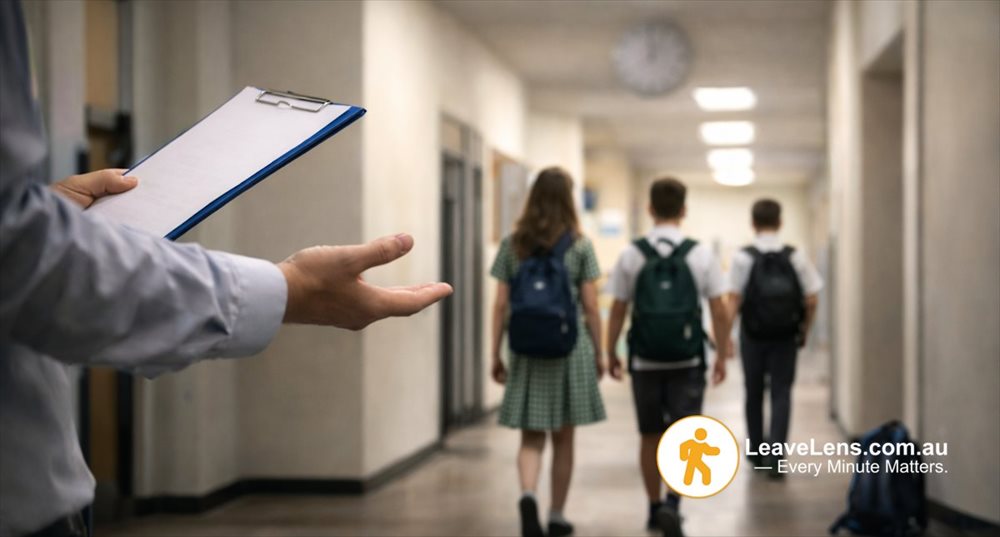
The most difficult school problems are rarely the ones that fit neatly into a policy.
Take something as ordinary as a student asking to go to the toilet during class.
On the surface, it sounds simple. A child needs the bathroom. A teacher either says yes or no, or simply delays an exit as long as reasonably possible. When you read through repeated discussions on reddit r/AustralianTeachers, that is not how teachers experience it at all. What they describe is a constant balancing act between compassion for genuine need and control over a pattern that can quickly erode learning, supervision, and school culture.
Teachers are trying to protect students with legitimate needs. They know there are medical issues, menstruation, anxiety, disability, and plain bad timing. Many describe making judgement calls based on the student, the situation, and the timing of the request. They do not want to humiliate a student or create a moment that becomes bigger than it needed to be. That is the compassion side of the equation.
However, the same discussions also show why schools become stricter. Teachers describe students using bathroom trips to avoid work, sit on phones, roam the school, meet friends, vape, or disappear for long stretches of a lesson. In some schools, toilets are discussed not just as amenities, but as unsupervised spaces linked to vandalism, fights, bullying, and other unsafe behaviour. That is the control side of the equation.
And that is where the real problem begins.
Because once a school has enough of these incidents, classroom decisions stop being about one student and one toilet break. They become operational decisions. One student out at a time. Signed slips. Keys. Swipe cards. Locked toilets during class time. Only certain blocks open. Teachers on toilet duty. Cameras outside corridors. Vape detectors. In one thread, a teacher jokes that staff have effectively become “bouncers for the toilets”. It is funny because it is absurd. It is also funny because it is true.
This is the point many schools miss.
The issue is not really toilets.
The issue is that schools are being forced to manage out-of-class time with systems that were never designed for visibility. Teachers are left making judgement calls in real time, with limited information, inconsistent processes, and no easy way to separate a genuine need from a recurring pattern. The result is friction everywhere. The genuine student feels mistrusted. The teacher feels manipulated. Leadership hears anecdotes but struggles to see the full picture.
This is why the best schools often feel stuck.
If they loosen control, some students exploit it. If they tighten control, innocent students can wear the burden of a system built to respond to the worst cases. In one discussion, a parent points out that shy students and compliant students are often the true victims when schools have to lock down access because of vandalism, vaping or truanting. That is the hidden cost of a blunt response.
There is also a cost that rarely gets named clearly enough: lost learning time.
When a student leaves class repeatedly, it is not just a welfare issue or a behaviour issue. It is an accumulation issue. Minutes disappear from explanation, modelling, guided practice, assessment preparation, and class culture. Teachers in these discussions talk about students asking right after breaks, during key teaching moments, or whenever work becomes difficult. Even when each trip seems minor, the pattern is not.
That is why this problem deserves better language.
Not “toilet policing”. Not “kids these days”. Not even just “vaping” or “vandalism”.
It is a visibility problem around student movement and lost class time.
And once you see it that way, the next step becomes much clearer.
Schools do not need to choose between compassion and control as if those are opposites. They need systems that allow both. Systems that let staff respond humanely in the moment, while still creating enough visibility to identify patterns over time. Systems that help schools distinguish isolated need from repeated avoidance. Systems that make it easier to support the student who genuinely needs flexibility, while also addressing the student whose “toilet break” is really a predictable exit from learning.
That is the gap many schools are trying to patch with paper slips, keys, sign-out books, swipe cards, office-only access, and ad hoc monitoring. Those workarounds tell us something important: schools already know this matters. They are already trying to solve it. The question is whether they are solving it in a way that gives teachers less burden, leadership better evidence, and students a fairer system.
Good schools are not confused about whether students should have dignity.
They are trying to work out how to protect dignity without surrendering visibility.
That is a much harder problem. But it is also the real one.
If your school has ever found itself tightening toilet rules, limiting access during class, or wondering where learning time is quietly going, it may be worth asking a better question:
Are we managing toilets, or are we trying to manage invisible time out of class?