Teacher Snapshot gives every teacher a clearer view of student exits, lost learning time and class movement patterns
Teacher Snapshot gives staff a concise, classroom-level view of how student exits are affecting their lessons, their students and their wider teaching context.

A clearer picture for every teacher
LeaveLens has always helped schools understand what happens when students leave class during scheduled learning time. The platform records exits and returns, highlights time out of class, and gives schools a more reliable way to discuss patterns that are often difficult to see in the moment.
The latest update extends that visibility directly to teachers through a new page called Snapshot.
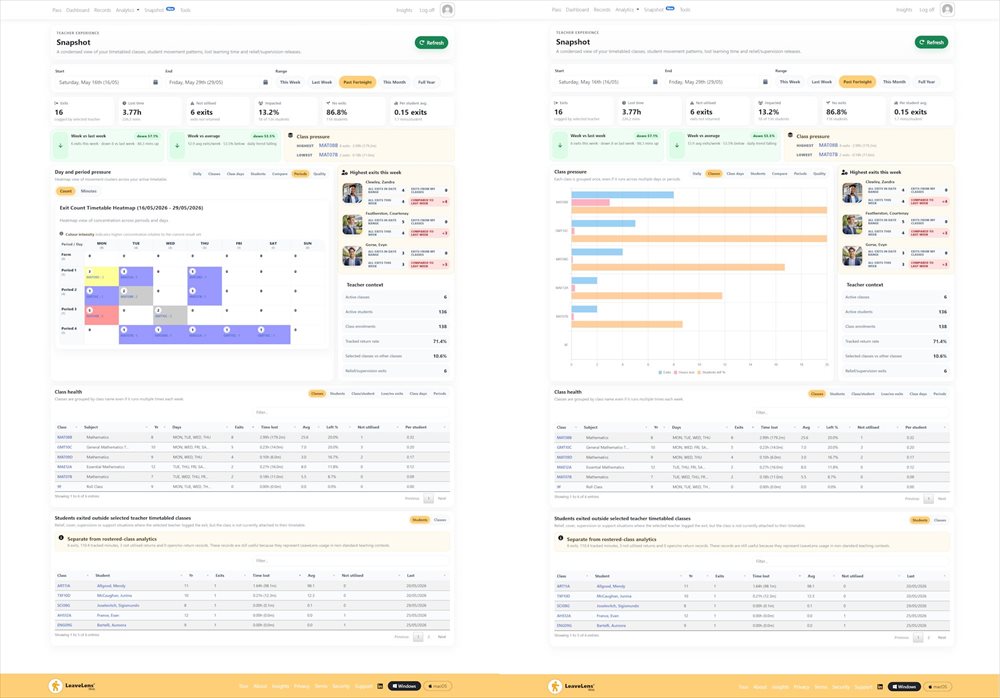
Snapshot is designed specifically for the logged-in teacher. It gives staff a compact, visual overview of the students they teach, the classes they are timetabled to, and the movement patterns connected to their lessons.
Instead of only seeing individual exit events, teachers can now see broader patterns across their own teaching load.
Why Snapshot matters
In a busy classroom, each individual exit can feel minor.
One student leaves for a drink. Another asks to use the toilet. A student is sent to IT. Someone else is out for support. In isolation, these moments can seem small and disconnected.
But across a week, fortnight, term or year, those small moments can add up.
Snapshot helps teachers answer questions such as:
- Which of my classes are experiencing the most exits?
- Which students are repeatedly leaving lessons?
- How much tracked learning time is being lost?
- Are exits increasing or decreasing compared with last week?
- Which students rarely or never leave class?
- Are the students I teach also leaving frequently in their other classes?
- Are some days or periods creating more movement than others?
- How many records were not fully utilised because the return was recorded by the system?
These are not just administrative questions. They are teaching, learning, wellbeing and duty-of-care questions.
Built around the teacher’s own timetable
Snapshot focuses on the teacher’s current school and active classes.
This means the data is filtered to the students and subjects connected to the logged-in staff member. Rather than presenting whole-school data that may be too broad to act on, Snapshot provides a teacher-level lens.
Teachers can see:
- their active classes
- active students they teach
- exits from their own timetabled classes
- tracked lost learning time
- class-level pressure
- students with repeated exit patterns
- students who rarely leave class
- movement by day and period
- return quality and not-utilised records
This helps make the data more relevant and easier to interpret.
Movement trend: seeing whether exits are getting better or worse
One of the key additions in Snapshot is movement trend analysis.
The page compares current activity against recent and longer-term patterns. Teachers can see whether exits are trending up, down or remaining stable.
An increase is shown clearly as a concern. A decrease is shown as an improvement.
This matters because raw counts alone do not always tell the full story. A class with ten exits may be improving if it previously had twenty. Another class with four exits may be worsening if it usually has none.
Snapshot helps teachers see direction, not just totals.
Class pressure: identifying where the impact is concentrated
Snapshot includes class pressure insights to show which classes are being most affected by student movement.
This helps answer questions such as:
- Which class has the highest number of exits?
- Which class has the most lost learning time?
- Which class has the lowest meaningful exit pressure?
- Are certain subjects or class groups requiring closer attention?
This is useful for teachers because the pattern is often not evenly distributed. One class may account for a large share of movement, while another class with the same teacher may have very little.
That difference is important. It suggests the issue may be connected to a specific cohort, time of day, classroom routine, lesson structure, group dynamic, wellbeing need or avoidance pattern.
Supporting better conversations
The goal of Snapshot is not to blame students or teachers.
Its purpose is to make patterns visible.
When schools can see reliable data, conversations can become more focused and less reactive. Instead of relying on memory, frustration or isolated incidents, staff can talk about patterns.
A conversation can move from:
“This student is always leaving class.”
to:
“Across the past fortnight, this student has left multiple classes, with most movement occurring during particular periods. In your class, the pattern is lower, but across their timetable it is increasing.”
That is a very different conversation.
It is more accurate, more professional and more useful.
Every Minute Matters
LeaveLens is built around a simple idea: every minute matters.
When students are out of class, learning time is affected. Sometimes the reason is entirely valid. Sometimes it reflects a wellbeing need. Sometimes it points to avoidance, peer coordination, disengagement or inconsistent routines.
The value of LeaveLens is not in preventing students from accessing legitimate support or basic needs. The value is in helping schools see patterns clearly enough to respond well.
Snapshot brings that visibility closer to the classroom teacher.
It gives teachers a clearer view of the students they teach, the classes they lead, and the learning time that may be slipping away in small moments across the school week.
That is the purpose of the new Teacher Snapshot page: a practical, teacher-level lens on student movement, lost learning time and classroom patterns.