The five-minute request that quietly becomes an hour
A five-minute bathroom request can feel minor in the moment, but repeated across lessons and across a week it quietly becomes a significant amount of lost learning time. This article reflects on the teacher experience of managing those requests, the judgement calls involved, and why small repeated exits can reveal a much bigger pattern.

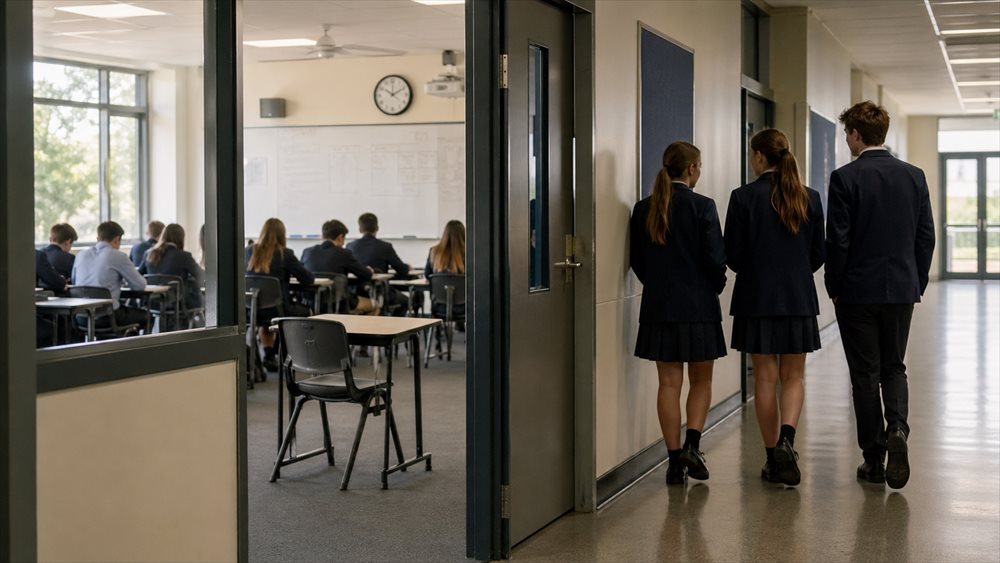
As a teacher, I do not think many of us start out believing that a five-minute bathroom request matters all that much.
A student puts their hand up. They ask to go. You glance at the clock, weigh up the moment, and make a call. In isolation, it feels small. Human, even. Certainly not something worth turning into a big issue.
But one of the things I learned over time is that schools are rarely dealing with one five-minute request.
They are dealing with the same request repeated across a day, across a week, across multiple teachers, across multiple subjects. And that is where the real problem starts to come into focus. In teaching discourse groups, teachers keep coming back to this exact experience: “ask me again in 5 minutes”, “one at a time”, “not during the I do”, and “be back in 5 minutes” are not really hard rules so much as coping mechanisms for a problem that keeps repeating in small doses.
I can picture the kind of situation that sits behind so many of those comments, because most teachers have lived some version of it.
At first, it is one student asking regularly to leave class. You do not want to be unreasonable. You do not want to embarrass them. You do not want to be the teacher who turns a bathroom request into a power struggle. So you say yes. Then it happens again tomorrow. Then again in another lesson. Then another teacher mentions they are seeing the same thing. Eventually you realise you are not looking at random moments anymore. You are looking at a pattern.
That is the part I think schools often underestimate.
Lost learning time does not usually arrive with a dramatic headline. It leaks out in five-minute chunks.
Five minutes during explicit instruction. Five minutes when the task is being explained. Five minutes when the rest of the class is settling into work. Five minutes at the end of the lesson when the recap happens.
And once that starts happening several times a week, the impact is no longer minor. Teachers regularly talk about being more cautious during explicit instruction for exactly this reason: those minutes are often the most instructionally valuable part of the lesson.
What makes it harder is that teachers are trying to hold two truths at once.
The first is that some students genuinely need to go. There are medical issues, menstruation, anxiety, stomach issues, and all the ordinary realities of being a young person at school. The second is that some students are clearly using the request to avoid work, leave an uncomfortable moment, break up the lesson, or simply get out of class. That is why the “ask me again in five minutes” approach has become so common. It is not always about denying access. Often, it is a quick way to distinguish genuine urgency from a request that is really about leaving the room.
That is such an uncomfortable judgement call to have to make, especially over and over again.
As a teacher, I think that is what wears you down most. Not the request itself, but the constant need to interpret it. You are not just teaching. You are deciding whether this is urgent, whether someone is already out, whether this student asked last lesson too, whether now is the worst possible time in the lesson to miss the explanation, and whether you will need to follow it up later.
I also think this is why some of the more controversial school responses are emerging.
Recent Australian reporting has described schools trialling sign-in and sign-out systems, teacher-issued passes, bathroom-use logging, and parent notifications when students leave class for the toilet. Those responses attract strong opinions, and understandably so. But underneath them is a reality many teachers would recognise immediately: once enough of these little exits add up, schools start looking for ways to make the pattern visible.
And visibility is really the heart of the issue.
Because one teacher may notice that a student leaves for ten minutes every Thursday period 3. Another may notice that the same student disappears during independent writing. Someone else may know it is happening in maths as well. But unless those moments are connected, each one stays small enough to dismiss. The cumulative loss is real long before it becomes obvious.
If I were reflecting on this as a teacher, I would probably say this:
The turning point is not when a student asks to go to the bathroom. The turning point is when you realise the same student has quietly been missing far more of their learning than anyone first thought.
That is the moment it stops feeling like a classroom annoyance and starts feeling like something more serious.
Because a student who misses five minutes here and there is not just missing time. They are missing explanation, modelling, routines, accountability, and continuity. They are missing the parts of the lesson that help everything else make sense. And once that time is gone, it is surprisingly hard to give back. Wider teaching commentary reflects this too: bathroom requests are not always about one thing, and sometimes they are tied to avoidance, distress, privacy, embarrassment, or other needs that are not obvious in the moment.
I think that is why this issue resonates so strongly with teachers.
Not because we want to control every movement. Not because we do not trust students. But because we know how much teaching and learning can be lost in what looks, on paper, like “just five minutes”.
And maybe that is the question more schools need to ask:
When a student leaves for five minutes, are we seeing a small interruption — or the visible edge of a much bigger pattern?
That is where the real conversation starts.
References
- The real reasons kids ‘go to the loo’ halfway through a lesson, https://www.tes.com/magazine/archive/real-reasons-kids-go-loo-halfway-through-lesson.
- Aussie schools roll out controversial ‘toilet diary’ bathroom rules, https://www.news.com.au/national/nsw-act/news/australian-schools-introduce-signout-systems-to-monitor-student-toilet-breaks/news-story/67cea904857c79eb28a432e2a645b655.
- St Leo’s Catholic College monitors student toilet use via CCTV, https://www.news.com.au/lifestyle/parenting/school-life/sydney-school-tracking-students-bathroom-use/news-story/a6a4ac500bbde5f71d9f11415cba3286.
- Will Pantone’s ‘Period Red’ help us talk about periods?, https://www.tes.com/magazine/archive/will-pantones-period-red-help-us-talk-about-periods.