Introducing Record Reconciliation: Accurate Student Movement Data Without Interrupting Teaching
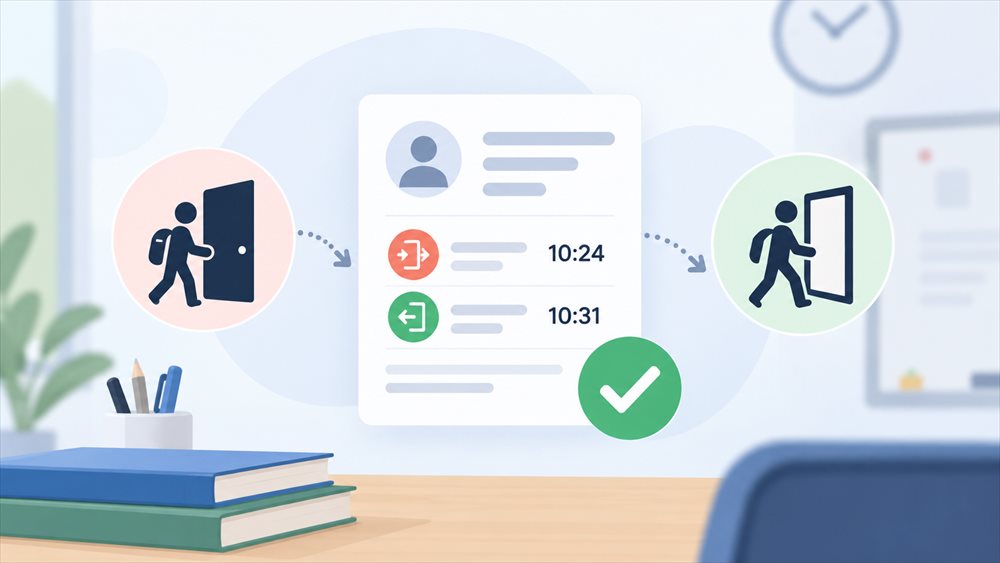
Teachers are busy teaching, and sometimes a student returns to class before their return can be recorded. LeaveLens Record Reconciliation allows staff to review incomplete student movements later, correct return times and maintain accurate lost learning time analytics.

Teaching comes first
One of the realities of classroom teaching is that not everything happens at a convenient moment.
A teacher might record a student leaving the classroom, continue delivering the lesson, answer another student's question, manage an activity, move between groups, deal with behaviour, or simply become focused on teaching.
The student returns. The lesson continues. Recording that return in LeaveLens gets missed.
That does not necessarily mean the student remained out of class for the rest of the lesson. It means the digital record was never completed.
Our new Record Reconciliation workflow is designed specifically for this situation.
What happens when a return is missed?
When a lesson ends, LeaveLens automatically clears outstanding classroom exits that have not been returned. This prevents a student from continuing to appear as actively out of class after the lesson has finished.
Importantly, LeaveLens does not simply assume that the student remained out until the end of the lesson.
The exit is retained as an incomplete record requiring reconciliation. This means the school still knows that the movement occurred, while avoiding the creation of misleading lost learning time data from a return time that was never actually recorded.
A new Reconcile Records workflow
Staff can now access Records > Reconcile Records to review recently incomplete student movements.
The reconciliation view focuses on records from the current and previous week, allowing staff to deal with them while the lesson is still reasonably fresh in their memory.
For each record, LeaveLens provides the important context around the movement, including the student, lesson, original exit time and when the lesson ended.
The teacher can then answer a much simpler question:
How long was the student actually out of class?
Staff can use quick timing options to estimate how long the student was out, or select a specific return time where they know it.
Any return time entered must fall between the student's original exit time and the end of the lesson, helping prevent accidental or impossible times from being recorded.
Once reconciled, the record becomes a completed student movement and can contribute appropriately to LeaveLens lost learning time analytics.
What if the record should not exist?
Sometimes the issue is not a forgotten return time.
A student might have been selected accidentally, an exit could have been recorded twice, or the teacher may determine that the record does not represent a genuine student movement.
Reconciliation also provides the ability to remove an incorrect record rather than forcing staff to invent a return time simply to complete it.
The goal is better data, not just complete fields.
Keeping analytics meaningful
This matters because LeaveLens does more than display who is currently out of class.
Completed exit and return records contribute to measures including:
- Total lost learning time
- Average time out of class
- Student movement frequency
- Class and subject patterns
- Year-level and faculty trends
- Historical student movement analysis
If a student was actually out of class for seven minutes but an incomplete record was interpreted as 40 minutes, the resulting analytics would be misleading.
Equally, deleting every incomplete exit would remove useful evidence that the movement occurred at all.
Reconciliation provides the middle ground.
LeaveLens retains the original exit, identifies that its duration has not been reliably captured, and allows staff to correct the record when they have the opportunity.
Designed around what actually happens in classrooms
Technology used in classrooms needs to recognise that teachers are not data-entry operators.
There will be times when a student's return is recorded immediately. There will be times when it is recorded a few minutes later. And there will be times when the lesson gets busy and it is missed altogether.
Record Reconciliation allows LeaveLens to accommodate all three without turning a forgotten click into unreliable data.
How reconciliation works
- The student leaves.
- Their classroom exit is recorded in LeaveLens.
- The student returns.
- The teacher may not always have an opportunity to record the return immediately.
- The lesson ends.
- LeaveLens safely closes the active classroom status without assuming an inaccurate return time.
- The record becomes available for reconciliation.
- Staff can review incomplete records from the Records area.
- The teacher reconciles the movement.
- They can select an appropriate duration, enter a return time, or remove the record if it was created incorrectly.
- The record is completed.
- The reconciled movement can then contribute accurately to LeaveLens analytics.
Better records without adding pressure
Accurate information matters, particularly when schools begin looking beyond individual exits and analysing patterns across weeks, terms and entire cohorts.
But accuracy should not come at the expense of lesson delivery.
Record Reconciliation is designed to make LeaveLens more forgiving of the realities of a busy classroom while improving the quality of the information schools ultimately use.
Because sometimes the student returned five minutes ago.
The teacher was just busy teaching.